

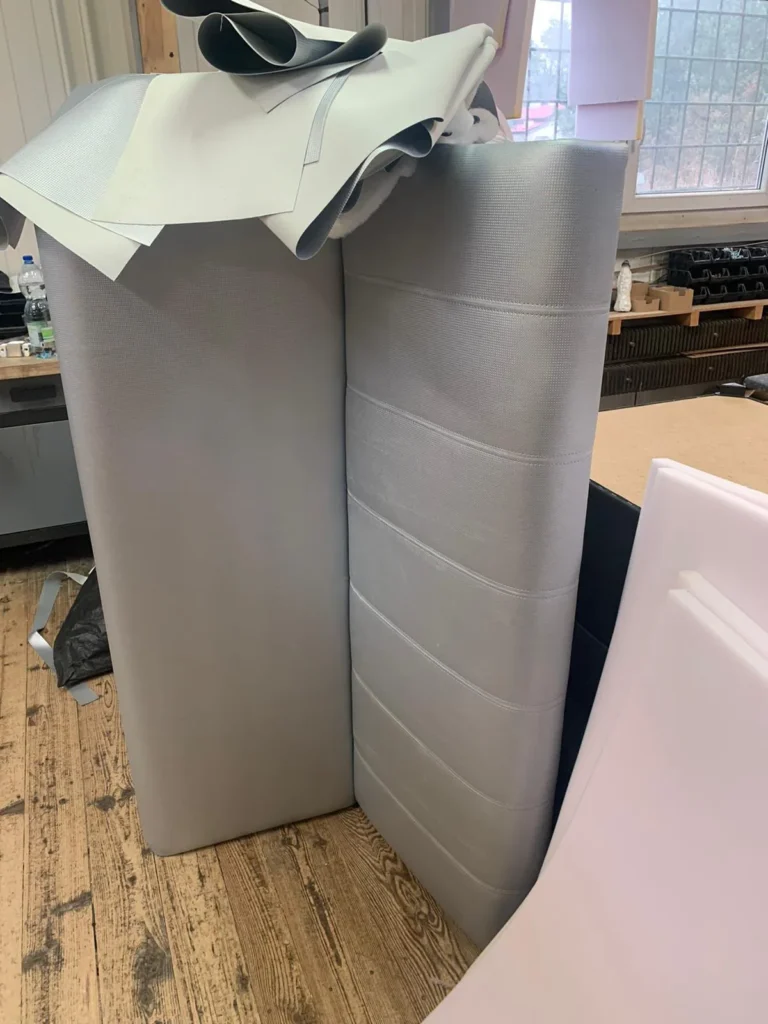
When a hotel, club, or restaurant looks for custom-made upholstered furniture, the first questions are about appearance, color, and lead time. Less frequently asked is the factor that actually determines the profitability of the purchase: how long this furniture will withstand daily use. The answer is only visible years later, not upon order delivery.
Why durability matters more than first impressions
Furniture in a commercial space behaves differently than in a home. Guests sit down and stand up dozens of times a day, drinks get spilled, and upholstery is cleaned regularly, sometimes with aggressive agents.
Furniture that looks great in a photo, but loses its shape after two years, costs more overall than a more expensive model that will last a decade. When furnishing several rooms at once, this difference becomes visible in the budget immediately, because the replacement cost is multiplied by the number of rooms.
What determines durability: three elements and how they are joined
The durability of upholstered furniture breaks down into three elements that wear out at completely different rates.
The frame is the skeleton of the furniture. Solidly made, using appropriate materials and joints, it withstands over a dozen years of intensive use without deformation. It is what determines whether the furniture can even be restored after years or if it needs to be replaced entirely.
Foam determines comfort and how long the furniture holds its shape. Cheap foam loses its elasticity after months, while a well-chosen one withstands years of regular, intensive sitting.
The fabric wears out the fastest because it is the only one in constant contact with the guest and cleaning agents. All fabrics that we offer for hospitality venues have a minimum of 40,000 cycles Martindale, and the majority of our range exceeds 100,000.
The method of connecting the structural elements also matters, meaning whether the frame is glued, screwed, or joined with dowels. On top of that, there is the quality of the stitching, because weak seams break right where guests sit the most. In our workshop, every item undergoes inspection before shipping.
A project that proves this: over 200 meters in Energy2000
In 2016, during an interior renovation, Energy2000 in Katowice ordered over 200 linear meters from us loges Box I. This is a disco, so the furniture was subjected to conditions that no hotel or restaurant booth will ever experience.
After eight years, the client returned with an inquiry about new furniture. Before proposing anything, we reviewed these booths together. The construction and foams were in good condition, and eight years of wear were visible only on the fabric. The room layout also worked flawlessly, so there was no reason to change it.
You can also see what upholstery looks like after working in a club for several years in 7 Heaven club in Brno, where not only the booths are upholstered, but also the walls and the stairwell. The opposite pole is decorative fabrics: in Cafe Beluga w Bonn we opted for velvet, which in a cafe operates at a completely different rhythm than faux leather in a nightclub.
In production since 2005 and not a single warranty claim
Since 2005, we have not had a single warranty claim or complaint in our upholstered furniture production. We write this as a fact from the workshop, not as an advertising slogan: with over 50 projects a year for hotels, restaurants, and entertainment venues, this is a number that is easy to verify by speaking with any of these clients.
This stems from the same cause as eight years Box I in a disco. A structure designed for intensive use does not break down after a single season, and fabric chosen for the venue's actual load does not wear out faster than the customer expects.
Pre-production prototype, or how we avoid a costly mistake
Before we sew a set for the entire dining room, the client views and tests the prototype. The order is always the same and we repeat it with every project for a restaurant.
| Step | What's happening |
|---|---|
| 1 | discussion about the room layout, number of seats, and interior character |
| 2 | proposal of models and fabric samples, matched for color, texture and durability |
| 3 | furniture prototype that the customer views and tests at home |
| 4 | After approving the prototype, we will start full-scale production |
The reason is prosaic. The fabric color looks different on a screen than in the light of a specific room, at a different time of day, and under different lighting. A prototype also makes it possible to check the comfort of the seat and the height of the backrest with existing furniture.
This is how we worked in Restbotanica in Katowice, where we started with samples and prototypes, and only then created the custom Paris sofa and its curved version. This process takes longer than ordering a ready-made model from the warehouse, but it removes the risk of a mistake across the entire showroom from the owner.
How to evaluate an upholstered furniture manufacturer before buying
Ask four things directly: what the frame is made of, what foam is used in the seats, how many Martindale cycles the proposed fabric has, and whether the manufacturer has experience with furniture subjected to heavy guest traffic. If you get a vague answer about the foam or the frame, it is a sign that the construction was not designed for long-term use.
Another good sign is projects from a few years ago, described in terms of how they are holding up today, rather than just fresh photos from the day of installation. A photo of furniture right after delivery says very little about its durability. Only an account from a customer years later shows whether the investment paid off.
Ask also whether the manufacturer reaches out years later on their own initiative, or if the contact ends together with the delivery.
What to do next
Tell us how many hours a day the piece of furniture will be in use, how often it will be cleaned, and whether the venue has certification requirements. Based on these three things, we select the foam and fabric before we start talking about color.
Daily care can extend the life of fabric more than choosing more expensive upholstery. We have gathered this in a separate guide about, how many years does an upholstered bed frame last and how to care for it. For a quote, call: +48 535 080 040.
Frequently Asked Questions
How long does upholstered furniture last in a commercial space?
The frame lasts for over a decade, the foam lasts for years, but the fabric wears out first. After eight years of heavy use in a nightclub, only the fabric needed replacement in Energy2000.
How many Martindale cycles should contract fabric have?
Minimum 40,000. Most of our offer exceeds 100,000 cycles.
How many complaints did you have?
Since 2005, we have not had a single warranty claim or complaint in the production of upholstered furniture.
Can furniture be restored after years?
It depends on the frame. A sturdy construction lasts over a dozen years and determines whether the piece of furniture can be refurbished or needs to be replaced entirely.
How to recognize a manufacturer who thinks about durability?
You can tell by the fact that they can give specific answers about the frame, foam, and Martindale, and that they show completed projects from years ago, not just photos from the day of installation.
Mariusz Wolski · owner of KAIZEN sp. z o.o. · in the furniture industry since 2005