
Booth Paris45
- Availability
- made to order
- Lead time
- 3 to 6 weeks
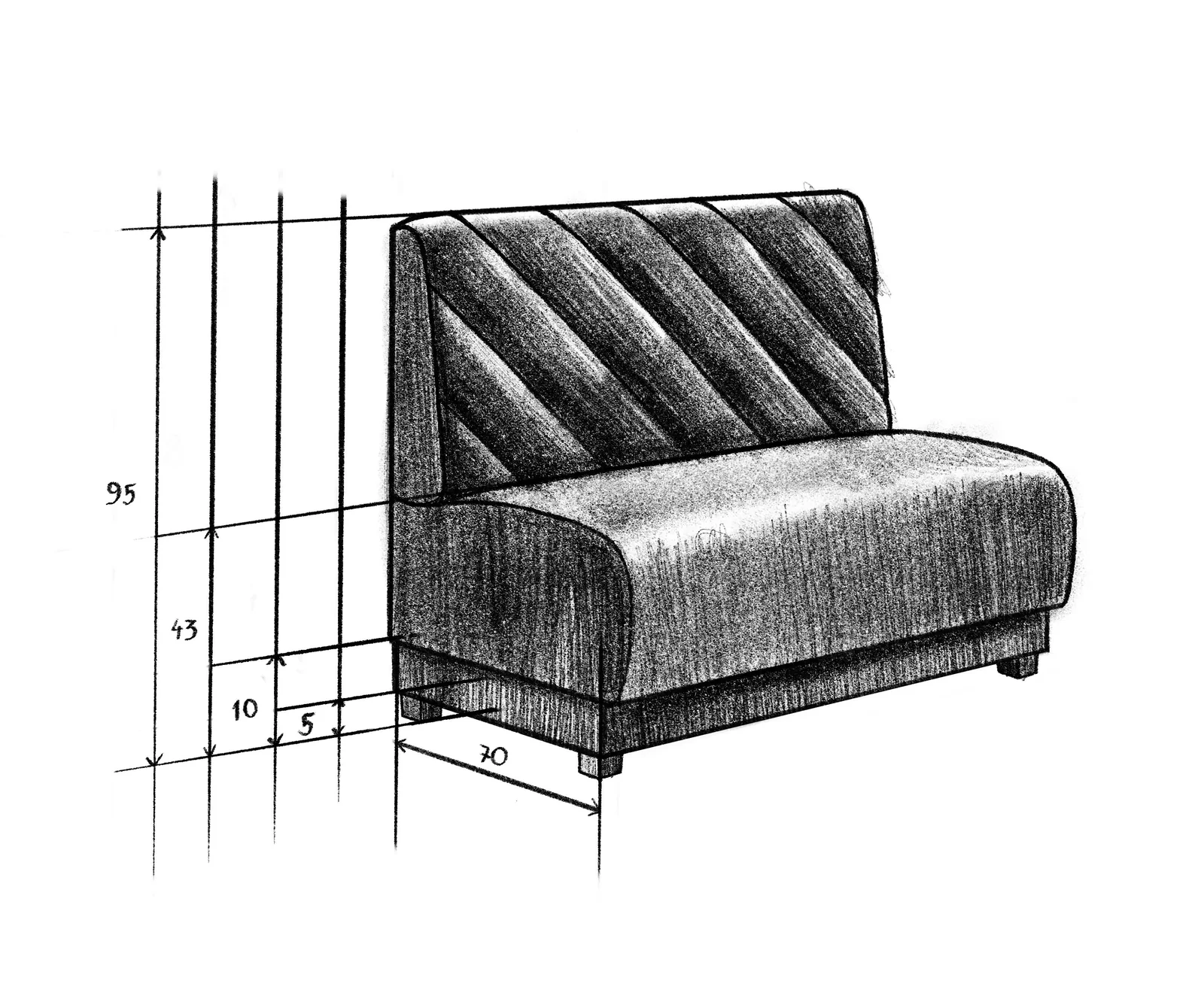
Dimensions in centimetres
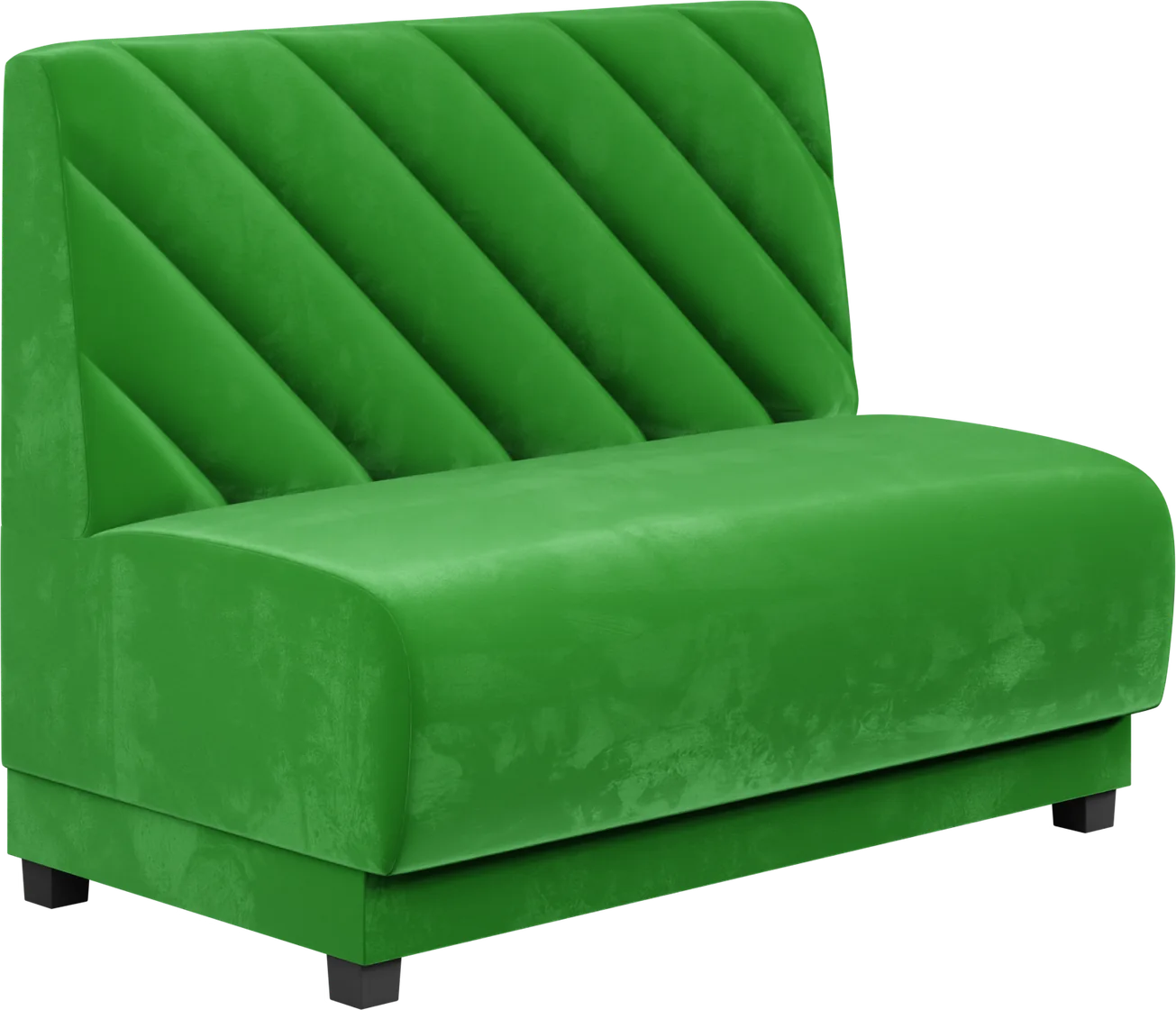
Paris45 is Paris with the channels running diagonally, at an angle of forty-five degrees. The number in the name comes from that angle.
The dimensions, depth and construction stay the same as in the base version: 70 cm deep, 95 cm high overall, seat 43 cm above the floor.
The diagonal changes how the furniture works in the room
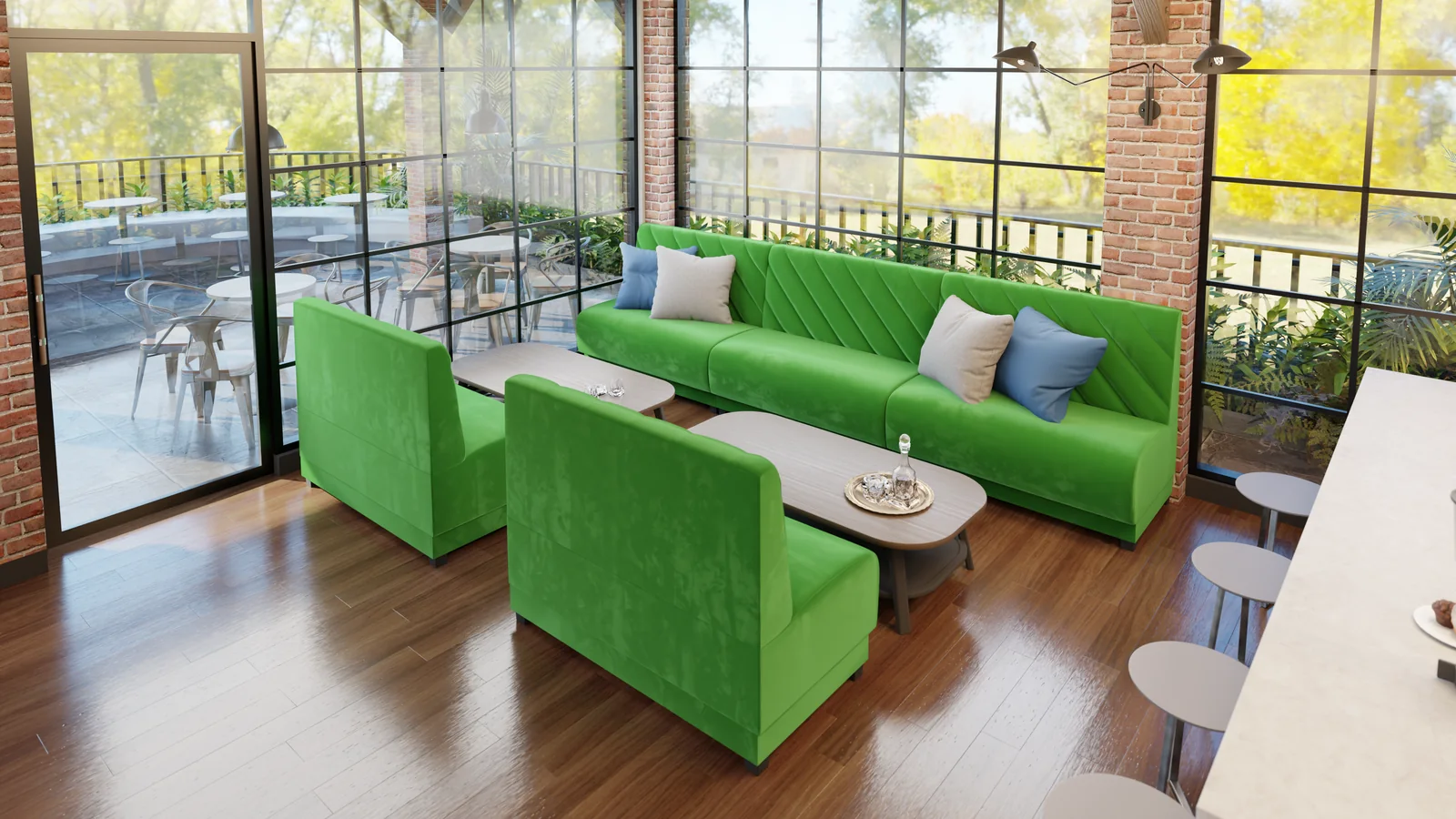
Vertical channels lead the eye upwards and make the backrest look taller. Diagonal channels lead it along the run and bring movement where the line of the furniture is static.
In a long, straight room this has a concrete effect: the diagonal breaks up the horizontal mass running along the whole wall and gives it direction. In a small interior with one short run the effect is the opposite, and the pattern can dominate a small surface.
So it is a choice made for the length of the run, not for the size of the venue.
Why the diagonal costs more
The PLN 100 per metre difference compared with Paris does not come from the material or the construction, because these are identical. You pay for the way the stitching runs.
A diagonal channel needs a different cut of fabric than a vertical one. The material is laid on the bias, so the pattern and weave have to match where segments meet, and every module has to be cut with the direction in mind. With vertical channels this problem does not exist.
The consequence when ordering: for a longer run made of several modules, we set the direction of the diagonal at the drawing stage, so that the lines pass through the joints without a break.
Dimensions and price
| Parameter | Value |
|---|---|
| Depth | 70 cm |
| Overall height | 95 cm |
| Seat height | 43 cm above the floor |
| Backrest | diagonal channels at 45 degrees |
| Standard module lengths | 1 m and 1.2 m, up to 1.4 m |
| Price | from PLN 850 per linear metre |
Paris45 or Paris Max
Both versions cost from PLN 850 per linear metre, but they give you something completely different.
| Paris45 | Paris Max | |
|---|---|---|
| What you pay for | more demanding stitching | a higher backrest |
| Overall height | 95 cm | 120 cm |
| Channels | diagonal | vertical |
| What it does in the room | gives direction to a long run | divides the space into zones |
If you need to set a zone apart, choose Paris Max. If the room is to stay open and the furniture is meant as an accent in it, choose Paris45.
Fabric with diagonal stitching
The channels create a strong surface pattern of their own, so a material with a clear pattern will compete with them. With this model plain fabrics work best, where the play of light on the rolls is the only effect.
Velour shows the channels more clearly than faux leather, because the pile lies differently on each curve. Every fabric we offer for venues has at least 40,000 Martindale cycles, and most of our range exceeds 100,000. We put the sample book together for a specific venue and send it within 1 to 2 working days of a conversation.
Lead time and ordering
Made-to-measure production takes 3 to 6 weeks, counted from the moment your payment is booked. The minimum order is one linear metre, and before production we ask for payment of at least half the value against a pro forma invoice.
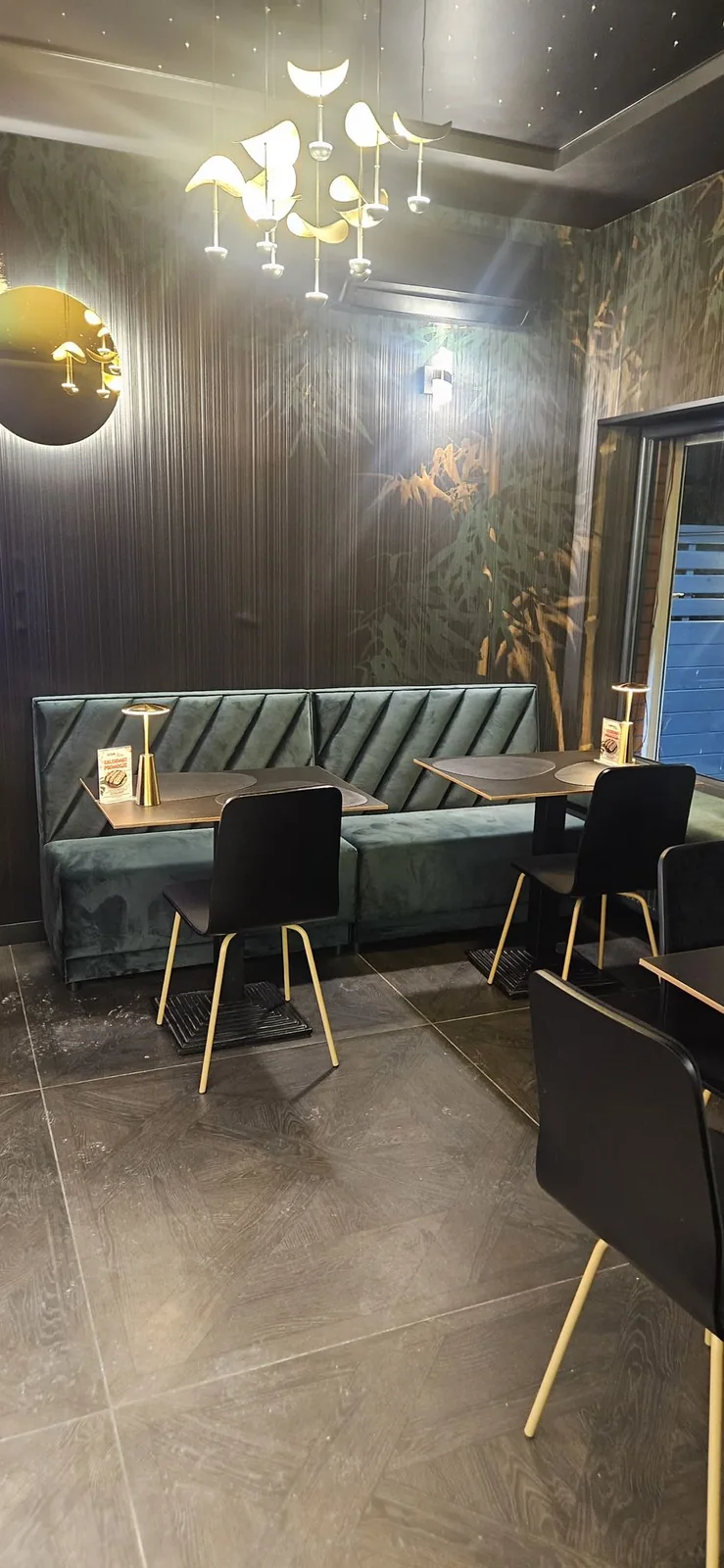
This model stands, among other places, at Krzywy Domek in Sopot, in the same family as the Booth Paris adapted to the curve of the wall: +48 535 080 040.
Frequently asked questions
Where does the name Paris45 come from?
From the angle at which the channels run on the backrest. It is forty-five degrees.
What are the dimensions of Booth Paris45?
Depth 70 cm, overall height 95 cm, seat 43 cm above the floor.
Why does Paris45 cost more than Paris?
Because of the way the stitching runs. A diagonal channel needs a different cut of fabric, and the lines have to match where the modules meet. The construction and material are identical.
Paris45 or Paris Max at the same price?
It depends on the job. Paris Max has a higher backrest and divides the room into zones. Paris45 stays at 95 cm and works as an accent in an open interior.
Which fabric for diagonal channels?
Plain, preferably. The channels create their own surface pattern, so a patterned material will compete with them.
Gallery